Tuesday, 25 September 2007

PSAlive at the BO? Not quite ...

The first all-French final of the British OpenWhen I read that PSAlive were to webcast the finals of the British Open 2007 for free, I quickly recovered from my strop at not being able to attend (thanks to Virgin Trains' exhorbitant fares - see this post) and eagerly logged on at 7.45pm.

The problem was, so did hundreds (thousands?) of others ...

I initially managed to hear some of the commentary, and also managed to log on to the live chat, which is an excellent idea that I didn't know was a feature of the service. Due to the over-running of the women's final, the men's did not start until aroun 8.30pm, and by this time I guessed a few people would have lost patience with the server problems.

The PSAlive server overloaded during the British Open finalsAll credit to the PSAlive team for offering the broadcast for free - a marketing idea that obviously proved too successful due to the terminal volume of traffic that tried to access the match.

Hopefully some of the visitors might be tempted to part with a few quid to access live events in the future or download archive matches.

Though the tournament lacked (probably) the best player in the world, it appears that it was very successful, with photos of the crowds at each round showed very encouraging attendance.

The progression of the players largely went to seeding, but this Open seemed to save the best till last, with Greg Gaultier's coming of age to take his biggest prize to date and Rachel Grinham's epic win over reigning champion Nicol David to take her third title.

PSAlive

Read more ...

Thursday, 20 September 2007

Not a spectator sport? Ditch the dogma

Not a spectator sport? 5000 Egyptians can't be wrong ...There's a particuarly cruel remark about the great game in the Guardian this week.

Barney Ronay's article on the glut of world championships being simultaneously held across a range of sports draws an unwarranted parallel, suggesting that squash is not a game for the spectator:

"Women's football, for example, is a perfectly good sport, in the same way squash and 10-pin bowling are: great if you're taking part, but do we have to watch them?"

Ronay should get himself up to Manchester this week to see some of the world's finest athletes compete in the world's most exciting sport.

Better still, take a trip to either Madrid or Bermuda to catch squash's own world championships in October and November.

Stumbling across this negative representation of squash, it suggested to me that this is precisely the thing that the newly-formed marketing department at England Squash should be keeping keeping an eye out for.

The article in full

Read more ...

Monday, 17 September 2007

Wolverhampton title timely for Beachill

Lee BeachillLast week's win for Lee Beachill's in the Wolverhampton Open 2007 could not have come at a better time.

The former world number has been out of the top ten rankings for nine months, and the win at the Edgbaston Priory club will surely give him confidence going into the British Open - a title he has never won.

Having seen Beachill many times in tournaments, he appears to be a player whose state of mind affects the outcome of his games more often than his physical condition.

An excellent mover and one of the best exponents of a good-length game, the 29 year-old from Yorkshire also possesses a cache of attacking shots founded on deception - weapons seemingly at odds with the stereotype of an attritional player.

However he never entirely looks like he is enjoying his work on court, with a dogged look on his face that belies a fierce determination. Sometimes the head goes down, but this is rarely followed by the capitulation that this kind of body language displays in other, more emotive, players.

More recently he seems to have suffered from a loss in self-belief that has seen him go out of events in earlier rounds. The reasons for this are unclear, though to many squash players with families, constant world travel is a strain and can impact on their motivation - especially when they have been, like Beachill, the best-ranked player in the world.

To train and focus on reaching the same heights once more must require a huge mental, as well as physical, effort.

A frustrated Beachill in the 2006 Super Series FinalLosing the Super Series

If one particular event sticks in my mind as a point when his confidence must have taken a huge knock, it is the final of the 2006 Super Series. Anthony Rickett's request to change the ball during a game caused chaos, with the officials unsure as to whether this was allowed in the rules. Beachill challenged the request, and was particularly miffed by the lack of guidance available at such an important time in the match. He walked off incensed after losing, clearly unsettled by what had happened.

He had the right to feel let down, though it subsequently turned out that his Australian opponent had acted within the letter (if maybe not the spirit) of the Super Series laws.

With the top ten in the men's game stronger than ever, Beachill will find it harder to get back up the rankings, especially now that Ramy Ashour has graduated from the juniors and looks set to dominate the senior ranks.

Having followed his career, I'd like to see the likable, self-effacing Pontefract man have another (maybe final?) assault on the rankings and be competing in some PSA finals pretty soon.

The win in Wolverhampton provides an excellent platform.

Wolverhampton Open 2007

Read more ...

Friday, 14 September 2007

A step in the right direction

Sounds like there's been some blue sky thinking ...Very encouraging to read that England Squash's new Chair, Zena Wooldridge, is planning the creation of a Marketing and Communications Team within her organisation.

Her comments were made in Issue 5 - 2007 of Squash Player magazine:

"... the idea is that Club Services would come under Marketing and use part-time external consultants (with experience in leisure and fitness industry) to provide expertise when needed."

I would have also liked to have seen "media consultants" included in the parentheses above, but at least this seems that a conscious effort (and the funding to back it up) is being devoted to widening participation by actively "selling" the sport.

As I had argued before, innovative marketing and media engagement is needed as much - if not more - than grass roots work.

England Squash

Read more ...

Sunday, 9 September 2007

English Grand Prix 2007

James Willstrop defeats Thierry Lincou in the final of the English Grand Prix 2007I had planned to attend the British Open in Manchester this autumn, however the prohibitive cost of a London-Manchester train ticket and accompanying accommodation meant that I would have to find another tournament (London events where art thou?).

There were a few to choose from, given the busy schedule of events this season. A £15 return fare on Chiltern railways to Birmingham made up my mind, and I headed up to the west Midlands for some squash and a balti.

Though the English Grand Prix hadn't attracted the same quality of entrants as the British Open, it wasn't the standard of squash that somewhat clouded my experience in Birmingham ...

For the Saturday (semi-final) night that I attended was the first evening of squash I'd seen that was dominated not by the players, but by the officials.

The first semi-final saw Australian David Palmer take on James Willstrop, with the World Champion Palmer looking lean and fitter than his much younger opponent. The match see-sawed back and forth, and from early on destined to go the distance - Willstrop using a greater range of shots to deceive his opponent, while Palmer content to work the ball to a more consistent length.

Spectators at the English Grand Prix 2007From my sidewall vantage point I couldn't see the referee and marker, and apparently there was a third official in place in order to give the "majority decisions" that were called at a number of disputed moments.

I've seen this system in operation before with three players used to officiate on close calls at Canary Wharf, but on this occasion (if the same system was in place), it didn't seem to work, and Palmer in particular came off worse. A disputed call when Willstrop was at match point did not inspire much confidence, as the officials seemed to look to the players for direction.

This was a close match between two evenly matched players, but Palmer can feel justified in feeling frustrated - the inconsistency in decision making clearly upset his rhythm. Given his tendency to vent his frustrations, all credit to him for accepting the decisions with grace.

The Aston Webb Great Hall at the University of BirminghamTaking a stroll round the Aston Webb Great Hall during the break between matches, I was able to appreciate what a dramatic venue for squash the promoters had found. The entrance of the players from high up above the stage was a nice touch, but seemed a little melodramatic given the relatively small number of spectators.

Though the back wall spectator area was sold-out, the sidewall section where we were seated had round tables with unreserved seating. This is more comfortable for the likes of tall people like squashblogger, though usually means that the promoters have sadly sold fewer tickets than expected (the tickets that were being given away during the week seemed to confirm this).

The crowd had some familiar faces, and seemed mostly to be from the squash community. Given the fact that the hall was in the middle of a campus university when the students are on holiday, this was not surprising - unlike the aforementioned Canary Wharf tournament, the event was unlikely to attract "passing" spectators.

To the promoters' credit, they seemed particularly attendant to the paying punters' experience, and we were asked a couple of times if we would like to move to the back wall to get a better view.

Stained glass window in the Great Hall at the University of BirminghamThis we duly did (thanks Paul Waters), only to see Greg Gaultier's match against compatriot Thierry Lincou (looking slightly sluggish compared in comparison after a five-gamer the previous night) similarly marred by poor officiating.

Gaultier, like Palmer, is less fractious now than his younger self, but he lost his temper a number of times here, and justifiably so. On the receiving end of some poor decisions (by this time the groaning back wall crowd had begun to sense that this was to be the common theme of the night), the Frenchman repeatedly asked the officials to justify why a let was given. On one occasion, Lincou simply slipped over - a good five feet away from his opponent - and a let was given. An incredulous Gaultier asked why, only to be told to shut up and get on with the game.

A spectator sitting in the sidewall seatingThe most bizarre incident occurred in the third, with Gaultier conceding that a ball was down. The officials obviously did not see whether the ball was indeed down, and asked the players for clarification. At this point something was lost in translation, with Lincou repeating the word "concede" - which the officials took to mean that he - and not Gaultier - was conceding the point!

I felt that the officials repeated requests for "Mr Gaultier" to get on with the game were masking the fact that they had lost touch with the match (the score was also misquoted at least once). The crowd new it, and even Malcolm Willstrop, sitting to my right, giving a withering shake of the head at the proceedings.

Gaultier lost in five, clearly unsettled by the repeated breaks in the games. Lincou did what he is best at - keeping his head down and plugging away until his opponent makes mistakes.

They were introduced as "friends" as the came on to court, but the unlikely provocation that they had to contend with might have gone someway to test that claim, given the number of times it was implied they had to sort sticky situations out for themselves.

Lincou and Gaultier warm up for their semi-finalThere will always be times in a fast-moving game like squash when players are called upon to show sportsmanship and act honestly. But both semis of this tournament strained this principle to unreasonable lengths. Maybe the fact that this was the first time I'd seen the officials have a bad game means that their usual "invisibility" is indicative of assured professionalism and excellent judgement. But tonight, they did have a shocker.

The trophy was won on Sunday by Willstrop in another game that went the distance - the English number one's "who dares wins" attitude during an attacking fifth game finally breaking down the Gallic challenge.

Right: a video of the last point of the final, as recorded by a spectator and posted on YouTube.

Willstrop beats Lincou 11/8, 11/8, 9/11, 7/11, 11/3 (77 mins)

Read more ...

Saturday, 8 September 2007

Freebie glossy covers English Grand Prix

The article in Myfreesport magazineNice to see that the glossy sport magazine given away to London commuters on a Friday devoting a small preview section to this week's English Grand Prix in Birmingham.

Myfreesport magazine carries at least one decent interview weekly, with pretty decent photography throughout, considering it's being given away.

I keep a look out for squash articles, as the content tends to be pretty eclectic. And lo and behold, last Friday carried an article on the Birmingham event.

More than can be said for our quality dailies - and I rather fear that the BBC's coverage this season might be diminished, given the fact that the RSS feed at the top of this page hasn't changed for a while.

Myfreesport magazine

Read more ...

Wednesday, 29 August 2007

Resurgent British Open - but where's Ramy?

The show court at the 2001 British OpenIt was heartening to read in International Squash magazine Jonah Barrington's enthusiastic endorsement of what he sees as a new "British circuit" emerging (extracts of which are reprinted here).

His comments related to the busy autumn and winter schedule of squash events currently being promoted in the UK. Britain's most successful squash player also commented on the history of the British Open, and how he felt that, with the kind of backing that it is currently being promised, should soon again regain its proud status as the "Wimbledon of squash" - the most prestigious tournament on the tour.

However, around the time I was reading Barrington's comments, the news also broke that Ramy Ashour - currently the hottest ticket in world squash - had decided not to play in next months' British Open in Manchester.

How does Ashour's non-appearance sit with Barrington's vision of the event's status?

Sarah Fitz-Gerald competes in the 2001 British OpenWhy the "Wimbledon of squash"?

I've linked these two stories because they are maybe more related than they first appear. Firstly, I've always found the British Open's claim to greatness through the moniker "the Wimbledon of squash" a strange one, for three reasons:

1. The phrase is bandied around in relation to more than one thing. I have read it used to describe the British Open in order to emphasise its history and prestigiousness. I've also seen it used to describe (hitherto) squash's most important venue in the UK, the now sadly closed Lambs club in London. This multiple use is confusing, and lessens the phrase each time it is (mis?)applied.

2. The Wimbledon Tennis Championships have been around for a long time - since 1877, in fact. Squash's British Open has been in existence since 1922 (for women - interestingly, for sport, the women's tournament has been around for longer than the men's) and 1930 (for men).

However the difference is more significant than in the time the respective events have existed. The great tennis tournament has been held at its landmark venue for the majority of those years, with all the history, drama and memories bound up with the players' and spectators' knowledge of what the "Wimbldeon experience" is - from queuing in the rain to strawberries and cream to "Henman Hill". The tournament is even named after a place (unlike the other tennis Grand Slams), and it is this sense of a sporting venue being special for two weeks of the year that makes for such a great experience.

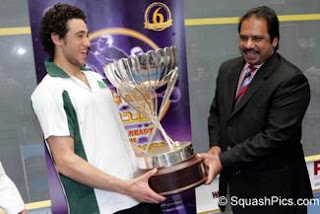
Ramy Ashour being presented with the Qatar Classic 2007 trophy by Jahangir Khan The British Open doesn't have this enigmatic claim, as it has moved over the years from city to city, venue to venue. The sense of occassion is simply not the same when a tournament is not rooted in the traditions of place.

3. Wimbledon is a tennis tournament, and squash maybe does itself a disservice by defining itself through its relation to another sport.

My argument is not that the British Open has not been (to date) the most important event in world squash. The records books show that it has. It is that the term "the Wimbledon of squash" is a misnomer. Barrington's enthusiasm for the event and his hopes for it to regain its previous hights will be shared by many squash fans (and players), but the degree to which it is possible is open to question, given the sport's decline over the past couple of decades.

Given the fact that the event has struggled over the past few years to attract a lead sponsor, one could argue that the British Open has long ago lost any claim it had to be the revered crown in the professional game. The World Open far out-muscles it in terms of prize money (this year the British Open musters $78,000 for the men's draw, compared to the World Open's $175,000), and it is clear that with the investment in the World title, together with hefty Middle East sponsorship from the likes of Ziad Al-Turki, has meant that the top players are beginning to look elsewhere for ranking points and a sizeable pay day.

Willstop and Ricketts battle it out in the 2005 British Open finalThe Open without the best player

Which brings me to Ashour's decision not to play in this year's competition at the National Squash Centre in Manchester. The tournament's failure to attract this year's top player (Ashour may not yet be the world number one, but it only seems like a matter of time) has received surprisingly little coverage in the squash media, maybe because the young Egyptian's decision may not have been entirely his own: "My manager recommended I didn’t play. It is not good for points. I need to concentrate on other events and watch the points."

I don't think that the British Open needs to boast the highest prize money of any event on the PSA or WISPA tours to retain a sense of its prestige. But it does require a level of sponsorship somewhere in the region of the big events in Qatar, Kuwait or Saudi Arabia in order for promoters to attract the top players.

What seems certain is that without comparable prize money and the ranking points that come with it, more players are likely to withdraw to keep fresh for more lucrative tournaments. History, it seems, may no longer be as important as it was.

But while history (and wanting to be part of an event that has a grand history) will always be important to some, so is change. Perhaps those of use who are well aware of the British Open's past should spend less time trading the tournament on its former glories and take a braver step into the future.

Paul Waters' internationalSPORTgroup clearly have the enthusiasm and a sense of vision that hopefully will tranlsate into the resurgence of the event that Barrington and many of those who love squash crave. The British Open is important to squash as, to an extent, it is its history.

The solution for how this braver step can be taken should thefore a question for the whole squash world, rather than the beliguered promoters who struggle from year to year to prevent the door closing on the Open's history for good.

Ramy Ashour pulls out of British Open 2007

Read more ...

Wednesday, 15 August 2007

Jansher announcement stuns squash world

Jansher Khan won the World Open 8 times and the British Open 6 timesThe squash world did a collective double-take this week, as reports coming out of Pakistan suggested that former world number one and multiple World and British Open champion Jansher Khan is to come out of retirement.

The 38 year-old from Peshawar has announced his intention to play in a "minor world-ranking event" in London in October. Details at scant at present, though the Reuters website reports that it will be held "in London from Oct 11".

Jansher retired in 2001, but believes that he is fit and ready to compete at a professional level once more:

"The reason for my comeback is that I feel I am mentally and physically fit to play the international circuit for another three to four years".

For fans such as myself who did not get to see the legend at the hight of his powers such an appearance is a must-see. For the current crop of male pros, the chance to play one of the game's greats is an intriguing prospect that would be hard to turn down and, as such, should help to boost the profile of the event and raise the prize purse on offer.

Watch this space.

Read more ...

Saturday, 11 August 2007

Lambs club finally closes

Squash courtThe squash courts of London's famous Lambs club fell silent for the last time on 31st July 2007.

The last match to be played at the club was between Lambs' manager Tim Garner and former world number one Peter Nicol.

The nine-court complex - often described as the "Wimbledon of squash" - was bought by developers and will be demolished to make way for a residential development.

The closure follows a two-year fight to save the famous club and preserve a facility that has been used by many of the world's greatest players over the years, including Jahangir Khan.

The loss of the nine courts means that City employees - potentially some of the most influential backers of the game - will have to find another club. This is easier said than done when leisure centres are closing squash courts to make way for more lucrative fitness suites.

A Lambs Action Team has been formed to try to for a new club under the banner, but has yet to find solid backing.

Read more ...

Wednesday, 25 July 2007

Al-Turki reveals tour plans

Ziad Al-Turki, the Saudi Vice-President of the ATCO Group and sponsor of the Saudi International, has revealed further plans to streamline the men's tour.

On the back of the recent seven-year, $675,000 agreement between the ATCO Group and the internationalSPORTgroup that will see a large rise in the prize money available for a number of high-profile events, Al-Turki has suggested that the PSA tour should concentrate in specific regional areas before moving on to others.

This seems sensible given the relatively small amounts of funding and prize money that squash players receive set against the high cost of air travel. Formula One does something similar, moving from continent to continent.

Speaking to Squashsite, Al-Turki said:

"The Tour show flow from Europe, to the US, to Asia and then back to the Middle East. Instead of which players are going backwards and forwards all over the place, which is wrong".

This seems reasonable, and will surely be received favourably by the players. Any money coming into the game will be welcomed, and Al-Turki seems a genuine squash enthusiast.

As I have noted before, though these plans suggest streamlining a tour that moves all over the world, the controlling "hub" of world squash seems to be moving from Europe to the Middle East.

Read more ...

Friday, 20 July 2007

Packed UK autumn schedule - but not for women and London

The 2006 British Open, held in NottinghamJudging by the amount of post flooding through my letterbox from the iSportGroup, it seems that the autumn schedule of professional squash events in England is being heavily promoted.

The British Open, ATCO Super Series Finals, English Grand Prix, Wolverhampton Open and British Grand Prix being touted before the end of the year. There is also December's English Open, ran by Eventis Sports Marketing.

The regional hosting of these events will be great for the sport in the UK - the English Grand Prix is to be held in Birmingham, The Super Series Finals and the British Open to be held at what is increasingly the venue of choice, the National Squash Centre in Manchester, and the Wolverhampton Open bringing top-level squash to the Black Country.

Cynics will say that is it refreshing that the captial is not hoarding all the best events, and that a regional spread of competitions allows fans across the country to see the pros in action more regularly.

It is great to see so many events competing for status in the space of a few months, though as I have said in a previous post, fans in the south of the country find it difficult to attend many of these events, with London not scheduled to hold any more professional tournaments before the end of the year.

Wot no WISPA?

Another query is lack of events for women. Only the British Open and Wolverhampton Open have a women's competition. Based in London, I can't remember the last time I saw a professional women's match that was not an exhibition, shoe-horned into the finals' day of a men's tournament.

I hope to get to a couple of these events, though I wonder if the amount of ticketing information I am receiving by post and email is indicative of poor sales for some of the lesser-known events; the British Grand Prix, for instance, still appears to be looking for sponsors and has no dates and venue given. Some of the others have no information on which players have confirmed their appearance.

Gripes about the lack of London competition aside, I hope these regional events attract the support they need to bring squash to a wider UK audience.

Read more ...

Wednesday, 11 July 2007

IOC gives squash new hope

199th IOC Session - Guatemala CityThe International Olympic Committee (IOC) has decided to make its rules for adding new Olympic sports more flexible - giving hope to squash after it failed to make the 2012 Games.

The IOC came to the decision in a recent session in Guatemala City.

The decision means that there are to be 25 core Olympic sports with three "floating" sports at the Olympics from 2020, with all up for review after each Games.

The IOC members will now drop or include new sports by a simple majority vote. Previously the IOC rules required a two-thirds majority before sports could be granted Olympic status.

When the old voting system was last used in 2005, squash was selected as one of two sports nominated for inclusion but failed to achieve the two-thirds majority required.

The International Olympic Committee

Read more ...

Monday, 9 July 2007

Morales: tengo gusto del squash

Evo Morales - with jumperWhen not riling the United States or transforming his country into a socialist utopia, apparently Bolivian president Evo Morales finds time for a game of squash.

A keen football player, Morales also likes a hit before dinner.

The squash court must be the only place he doesn't wear that famous jumper.

A man who has previously worked as a bricklayer, baker, trumpet player, harvester of sugar cane and llama herder doesn't sound like someone who shies away from hard work - and this must surely make him a fit and formidable opponent.

Does the fact that Morales plays squash suggest that the sport has socialist crudentials? Equality of access, cheap to play, rewarding hard work - and once the court door closes we are all equal within those four walls.

But how can this be so when squash's image is - to some degree - still associated with City boys and private members clubs - icons of capitalism (remember Gordon Gecko on court?)?

Discuss.

Read more ...

Sunday, 1 July 2007

Nicol '9th Greatest Sportsman'

Peter Nicol has been voted the "9th Greatest British Sportsman of the last ten years" in a Guardian blog poll.

Ok, so it was not exactly a scientific exercise (see the blog for the numbers who voted in their, er, masses).

But is was good to see the Guardian finding time to mention the sport, even though it was in an idle moment during a rain break in the Henman v Lopez match at Wimbledon.

The full list of the great and the good reads:

1. Lennox Lewis
2. Joe Calzaghe
3. Paula Radcliffe
4. Tim Henman
5. Ben Ainslie
6. Tony McCoy
7. Stephen Hendry
8. Colin Montgomerie
9. Peter Nicol
10. Phil Taylor

Edging out "The Power" - who'd have thought it?

Read more ...

Thursday, 28 June 2007

Nicol - 'Lessons I Have Learned'

Nicol featured on the BBC websiteYet another excellent feature on the BBC website, again centring on 'squash legend' Peter Nicol.

The feature is part of a series of video interviews with successful athletes where they describe lessons they have learned and their motivations to reach the top of their chosen sport.

While some of the Nicol's advice (such as techniques to develop the mental strength to perform at the highest level and gain an advantage over one's opponent) could come from high-performance coaching manuals, others such as a commitment to over-training as a means of knowing one's own limits are more idiosyncratic.

What the interview reveals is an incredibly strong-willed individual and suggests that coaching (even at professional level) cannot substitute for a singular ability to succeed on one's own terms.

Indecently, each time I've seen Nicol interviewed on the BBC he comes across as a natural media performer - why don't they sign him up?

Peter Nicol - Lessons I Have Learned
Watch the interview here.

Read more ...