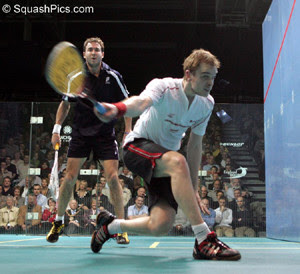
 On Sunday I went up to Manchester to watch the finals of the British National Squash Championships 2007.
As has come to be expected for this event, the organisation was slick and the standard of play high. The women's final saw a fit and focussed Jenny Duncalf overcome a two-game deficit to defeat Alison Waters, the latter maybe not at full strength after a bout of food poisoning (a point she graciously refused to use as an excuse).
In the men's final - played at a blistering pace - James Willstrop defeated John White in a punishing display of guile. I lost count of the number of winners Willstrop dropped in the front-court on the backhand side, out-thinking an opponent who managed to retrieve almost everything. How long can these guys' knees take the strain of so many high-impact lunges?!
The crowd - as usual in this city - were excellent, and gave great support to all players. There appeared to be more seating than in previous years behind the back wall, with the back tiers accessible from side gantries.
A first-timer to impress
 These seats were, encouragingly, all taken, though there did seem to be some confusion of which blocks of seats were which - a misunderstanding caused by tricky labelling on the tickets themselves rather than signposting around the court.
It also was the first time I had taken along my girlfriend to a professional squash event (indeed the first time she had been a spectator at any squash game) so it was interesting to gauge her reactions - not only to the sport, but also to the spectacle as an evening's entertainment.
The fact that I didn't have to clarify many of the rules throughout the evening said much for the accessibility of the sport, though explaining the difference between a let and a stroke left her somewhat miffed.
It was clear that this year's event was bigger and better than in previous years when the dry ice started billowing from the players' entrance tunnel. The walk-on music over the PA was cranked up to a thunderous volume - and that was just for the arrival of the compère.
Andy Nickeas: more of this please!
 For me, a large part of what makes events at the National Squash Centre stand out is Andy Nickeas (pictured, with winner Jenny Duncalf) as master of ceremonies. His knowledge of the players' standings and reputations is excellent, but importantly for big events like this he injects excitement into the crowd; he hypes a coming clash through an assured. understated delivery while avoiding the hyperbole that risks leaving us underwhelmed. Other sports fall victim to over-hype: squash doesn't get enough of it.
Although the men's final treated us to an astonishing display of skill, commitment and sportsmanship rarely seen in sporting contests of much greater media profile, it was not the confrontation many in the audience hoped to see. Lee Beachill - winner of this title three times - had to retire in his semi-final against Willstrop due to a neck injury, and many were hoping that the friends and training partners would meet in this year's final.
The draw and the former champion's misfortune meant that this would have to wait for another year.
Willstrop takes his first title
 Willstrop was a worthy winner, evident in Andy Nikeas's speech, when he spoke how James as junior had dreamt of one day playing on a glass court. I wonder if it was time constraints in the schedule that meant that the runners-up weren't interviewed before the winners (as is usual) after the matches. I thought this a little rum, though Waters in particular looked a forelorn figure on her chair by the court, so it was probably a blessing in disguise.
Having not known who was in the final of both draws before I arrived at Sportcity (my hotel proudly boasted wireless internet access, though I helpfully neglected to bring a laptop), I found Duncalf somewhat a surprise finalist (and winner). I've seen her a few times, and haven't witnessed the steely resolve manifest here against Waters; hopefully this success will infuse her with the confidence to put one over bigger names on the WISA tour.
Walking out to the taxi past the City of Manchester Stadium, I asked my girlfriend if she had enjoyed the evening. She had - very much so - and was pleasantly surprised by how dynamic squash could be as a spectator sport.
"It's the little things that really show up"
Over dinner at Dimitri's in the city centre I explained to her squash's image problems and the difficulties of maintaining a professional tour given the dearth of money around the sport. We both agreed that the event we had just witnessed was a well-organised event that was a great advert for professional squash; for someone like me who has been to many tournaments, I could appreciate how the Nationals do things better than other events.
I asked my girlfriend (who has been to many other sporting events) if there was anything she thought could have been done better. She laughed: there were a couple of things - insignificant to most of the audience, who could probably be classed as the 'squash community', but "it's the little things that really show up".
She elaborated. At one point duing the women's final, one of the stewards (almost certainly a volunteer) shouted "come on Jenny!". The comment was probably ignored around her, but was unprofessional coming from a staff member who, by virtue of her position, should be neutral in her allegiances. Here the comment fell on deaf ears; if it has been in a Wimbledon tennis final with half a million dollars at stake, things would have been taken a lot more seriously.
 Her second point was - on the face of it - even more trivial. The draw to win a squash racket at the end of the day was won by one of the volunteers rather than the audience, when it was the audience who were encouraged to buy programmes in order to enter the draw! From the compère's comment, it wasn't the first time this had happened.
These two incidents seem small, but to an new audience member they take the gloss off proceedings and cast a shadow over the professionalism that was evident throughout the day. As a national rather than international tournament, this event can perhaps be excused from being more "inward" looking than others, though those who seek to raise the profile of the sport shouldn't forget that there may be those in the audience seeing the sport for the first time, and that first impressions last.
These tiny observations aside, this year's Nationals was one of the best ran and most eagerly supported events I have attended - and a squash convert left Manchester that day.
Read more ...
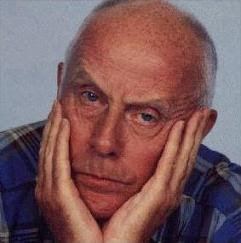 It turns out that Victor Meldrew (or rather the actor Richard Wilson) likes a game of squash!
 How is is that one of new London freesheets,
  The inherent flaw within this speculation, of course, is that many of us aren't old enough to have seen a player from an earlier era in their prime (though I bow to the wisdom of the more "mature" members of the squash community who witnessed Hashim Khan or Heather McKay at the height of their powers).
 Another check back at Wikipedia shows that the
  It is also unfortunate that women's sport in general receives less money than men's - for example, each summer tennis commentators debate the injustice of
  An irreverent and largely
 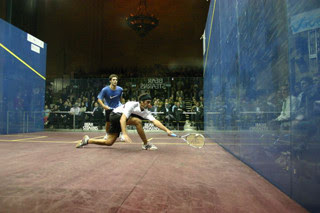 Great to see three Egyptian players in the top 10 of the
  I was as disappointed as everyone else when squash failed to make it into the 2012 London Olympics.
 An
An After all, rowing machines and treadmills were around in the 1980s at the height of squash's popularity, and did not hurt squash's success then. Rather than target sports centres and developers for what are sometimes hard business decisions made in an era of extraordinarily-high property prices (although I concede that publicly-funded centres have a remit to provide access to a wide range of activities), surely those who care about the future of the sport need to look closely at how squash is marketed by contrasting it with other successful sports/pastimes. This requires a co-ordinated marketing strategy underpinned by - almost certainly - a greater injection of cash from governing bodies.


